Rottweiler Breed Standard
FCI - Standard Nr 147 / 19.06.2000 / D
Translator: |
Mrs. Chris Seidler |
Origin: |
Germany |
| Date of publication of the valid original
standard: |
06.04.2000 |
Utilization: |
Companion, service and working dog |
| Classification FCI: |
Group 2 (Pinscher and Schnauzer type, Molossian type and
Swiss Mountain- and Cattle Dogs and other breeds) |
|
Section 2.1 Molossian type, Mastiff type |
|
With working trial. |
Brief Historical Summary
The Rottweiler is considered to be one of the oldest dog breeds.
Its origin goes back to Roman times. These dogs were kept as herder
or driving dogs. They marched over the Alps with the Roman legions,
protecting the humans and driving their cattle. In the region of
Rottweil, these dogs met and mixed with the native dogs in a natural
crossing. The main task of the Rottweiler now became the driving
and guarding of the herds of cattle and the defence of their masters
and their property. This breed aquired its name from the old free
city of Rottweil and was known as the "Rottweil butcher's dog".
 |
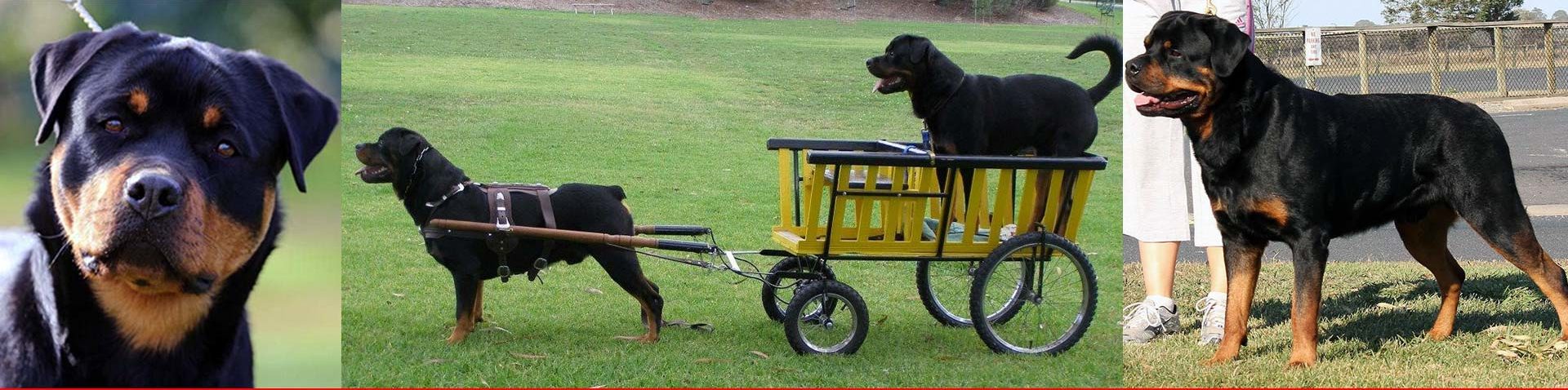
The butchers bred this type of dog purely for performance
and usefulness. In due course, a first rate watch and driving
dog evolved which could also be used as a draught dog.
When, at the beginning of the twentieth century, various
breeds were needed for police service, the Rottweiler was
amongst those tested.
It soon became evident that the breed was highly suitable
for the tasks set by police and therefore they were officially
recognised as police dogs in 1910. |
Rottweiler breeders aim at a dog of abundant strength, black coated
with clearly defined rich tan markings, whose powerful appearance
does not lack nobility and which is exceptionally well suited to
being a companion, service and working dog.
|
General Appearance
The Rottweiler is a medium to large size, stalwart dog, neither
heavy nor light and neither leggy nor weedy. His correctly proportioned,
compact and powerful build leads to the conclusion of great strength,
agility and endurance.
Important Proportions
The length of the body, measured from the sternum (breast-bone)
to the ischiatic tuberosity, should not exceed the height at the
withers by, at most, 15 %.
Behaviour / Temperament
Good natured, placid in basic disposition and fond of children,
very devoted, obedient, biddable and eager to work. His appearance
is natural and rustic, his behaviour self assured, steady and fearless.
He reacts to his surroundings with great alertness.
Head: |
|
Cranial Region: |
|
| Skull:
|
Of medium length, broad between the ears. Forehead line
moderately arched as seen from the side. Occipital bone well
developed without being conspicuous.
|
|
|
Stop: |
Well defined |
|
|
Facial Region: |
|
| Nose:
|
Nose well developed, more broad than round with relatively
large nostrils, always black.
|
|
|
| Muzzle: |
The foreface should appear neither elongated nor shortened
in relation to the cranial region. Straight nasal bridge,
broad at base, moderately tapered. |
|
|
| Lips: |
Black, close fitting, corner of the mouth not visible,
gum as dark as possible. |
|
|
| Jaws / Teeth: |
Upper and lower jaw strong and broad. Strong complete dentition
(42 teeth) with scissor bite, the upper incisors closely overlapping
the lower incisors. |
|
|
Cheeks: |
Zygomatic arches pronounced. |
|
|
| Eyes: |
Of medium size, almond shaped, dark brown in colour. Eyelids
close fitting. |
|
|
| Ears: |
Medium-sized, pendant, triangular, wide apart, set on high.
With the ears laid forward close to the head the skull appears
to be broadened. |
|
|
| Neck: |
Strong, of fair length, well muscled, slightly arched,
free from throatiness, without dewlap. |
|
|
Body: |
|
Back:
|
Straight, strong, firm.
|
|
|
Loins: |
Short, strong and deep |
|
|
| Croup: |
Broad, of medium length, slightly rounded. Neither flat
nor falling away |
|
|
| Chest: |
Roomy, broad and deep (approximately 50 % of the shoulder
height) with well developed forechest and well sprung ribs |
|
|
Belly: |
Flanks not tucked up. |
|
|
| Tail: |
In natural condition, level in extension of the upper line;
at ease may be hanging.
|
|
|
Limbs:
|
|
| Forequarters:
|
Seen from the front, the front legs are straight and not
placed too closely to each other. The forearm, seen from the
side, stands straight. The slope of the shoulder blade is
about 45 degrees to the horizontal.
|
|
|
Shoulders: |
Well laid back. |
|
|
Upper arm: |
Close fitting to the body. |
|
|
Forearm: |
Strongly developed and muscular |
|
|
Pasterns: |
Slightly springy, strong, not steep. |
|
|
| Front feet: |
Round, tight and well arched; pads hard; nails short, black
and strong. |
|
|
| Hindquarters: |
Seen from behind, legs straight and not too close together.
When standing free, obtuse angles are formed between the dog’s
upper thigh and the hip bone, the upper thigh and the lower
thigh and the metatarsal. |
|
|
Upper thigh: |
Moderately long, broad and strongly muscled. |
|
|
Lower thigh: |
Long, strongly and broadly muscled at top, sinewy. |
|
|
Hocks: |
Sturdy well angulated hocks; not steep. |
|
|
| Hindfeet: |
Slightly longer than the front feet. Toes strong, arched,
as tight as front feet. |
|
|
| Gait:
|
The Rottweiler is a trotting dog. In movement the back
remains firm and relatively stable. Movement harmonious, steady,
full of energy and unrestricted, with good stride.
|
|
|
Skin: |
|
| Skin on the head:
|
Overall tight fitting. When the dog is alert, the forehead
may be slightly wrinkled.
|
|
|
Coat: |
|
Hair:
|
The coat consists of a top coat and an undercoat. The top
coat is of medium length, coarse, dense and flat. The undercoat
must not show through the top coat. The hair is a little longer
on the hindlegs.
|
|
|
| Colour: |
Black with clearly defined markings of a rich tan on the
cheeks, muzzle, throat, chest and legs, as well as over both
eyes and under the base of the tail. |
|
|
Size/weight: |
|
| Height at Withers: |
For males is 61 - 68 cm. |
|
61 - 62 cm is small height |
|
63 - 64 cm is medium height |
|
65 - 66 cm is large height - correct |
|
67 - 68 cm is very large height |
|
|
Weight: |
Approximately 50 kg |
|
|
Height at Withers: |
For bitches is 56 - 63 cm |
|
56 - 57 cm is small height |
|
58 - 59 cm is medium height |
|
60 - 61 cm is large height - correct |
|
62 - 63 cm is very large height |
|
|
Weight: |
Approximately 42 kg |
|
|
| Faults: |
Any departure from the foregoing points should be considered
a fault and the seriousness with which the fault should be
regarded should be in exact proportion to its degree. |
|
|
General appearance: |
Light, weedy, leggy appearance. Light in bone and muscle. |
|
|
| Head: |
Hound-type head. Narrow, light, too short, long or coarse
head. Flat forehead (lack of stop or too little stop). |
|
|
| Foreface: |
Long or pointed muzzle; split nose; Roman nose (convex
nasal bridge) or dish-faced (concave nasal bridge); aquiline
nose; pale or spotted nose (butterfly nose). |
|
|
Lips: |
Pendulous, pink or patchy; corner of lips visible. |
|
|
Jaws: |
Narrow lower jaw. |
|
|
Bite: |
Pincer bite. |
|
|
Cheeks: |
Strongly protruding. |
|
|
Eyes: |
Light, deep set. Also too full and round eyes; loose eye-lids |
|
|
| Ears: |
Set on too low, heavy, long, slack or turned backwards.
Also flying ears or ears not carried symmetrically. |
|
|
Neck: |
Too long, thin, lacking muscle. Showing dewlap or throaty. |
|
|
Body: |
Too long, too short or too narrow. |
|
|
Back: |
Too long, weak; sway-back or roach back. |
|
|
Croup: |
Too sloping, too short, too flat or too long. |
|
|
Chest: |
Flat ribbed or barrel shaped. Too narrow behind. |
|
|
Tail: |
Set on too high or too low. |
|
|
| Forequarters: |
Narrow or crooked front legs. Steep shoulder placement.
Loose or out at elbow. Too long, too short or too straight
in upper arm. Weak or steep pastern. Splayed feet. Too flat
or too arched toes. Deformed toes. Light coloured nails. |
|
|
| Hindquarters: |
Flat thighs, hocks too close, cow hocks or barrel hocks.
Joints with too little or too much angulation. Dewclaws. |
|
|
Skin: |
Wrinkles on head. |
|
|
Coat: |
Soft, too short or too long. Wavy coat; lack of undercoat. |
|
|
| Colour: |
Markings of incorrect colour, not clearly defined.. Markings
which are too spread out. |
|
|
Eliminating Faults:
|
|
| General:
|
Distinct reversal of sexual type, i.e. feminine dogs or
masculine bitches.
|
|
|
| Teeth: |
Overshot or undershot bite, wry mouth; lack of one incisive
tooth, one canine, one premolar and one molar. |
|
|
Eyes: |
Entropion, ectropion, yellow eyes, different coloured eyes. |
|
|
Tail: |
Kink tail, ring tail, with strong lateral deviation. |
|
|
Hair: |
Definitely long or wavy coat. |
|
|
| Colour: |
Dogs which do not show the typical Rottweiler colouring
of black with tan markings. White markings. |
|
|
| Behaviour: |
Anxious, shy, cowardly, gun-shy, vicious, excessively suspicious,
nervous animals. |
|
|
| N.B.: |
Male animals must have two apparently normal testicles
fully descended into the scrotum. |
|